Pol Pot - Wikipedia, the free encyclopedia
en.wikipedia.org/wiki/Pol_Pot
WikipediaPol Pot (/pɒl pɒt/; Khmer: ប៉ុល ពត; 19 May 1925 – 15 April 1998), born Saloth Sar (Khmer: សាឡុត ស), was a Cambodian communist revolutionary who led ...
You've visited this page 4 times. Last visit: 7/31/14-
- the Diplomat - 1 day agoThe charges relate to the deaths of 20,000 ethnic Vietnamese and at least 90,000 Muslim Chams, allegedly slaughtered after Pol Pottook ...
- Telegraph.co.uk - 4 days ago
More news for pol pot
The Legacy of Pol Pot - Photo Essays - TIME
content.time.com/time/photogallery/0,29307,1948150,00.html
TimeTime Magazine photo essay on Pol Pot and the Cambodian genocide.Pol Pot in Cambodia 1975-1979 - The History Place
www.historyplace.com/worldhistory/genocide/pol-pot.htm
An attempt by Khmer Rouge leader Pol Pot to form a Communist peasant farming society resulted in the deaths of 25 percent of the country's population from ...Pol Pot - Facts & Summary - HISTORY.com
www.history.com/topics/pol-pot
The History ChannelFind out more about the history of Pol Pot, including videos, interesting articles, pictures, historical features and more. Get all the facts on HISTORY.com.Pol Pot Biography - Facts, Birthday, Life Story - Biography.com
www.biography.com/people/pol-pot-9443888
FyiKhmer political leader Pol Pot's totalitarian regime imposed severe hardships on the Cambodian people. Learn more at Biography.com.DEATH OF POL POT; Pol Pot, Brutal Dictator Who Forced ...
www.nytimes.com/.../death-pol-pot-pol-pot-brutal-...
The New York TimesApr 17, 1998 - Pol Pot, who created in Cambodia one of the 20th century's most brutal and radical regimes, died on Wednesday of heart failure, according to ...Pol Pot - Leader of the Khmer Rouge - 20th Century History
From 1975 to 1979, Pol Pot, as the leader of the Khmer Rouge, was the dictator of Cambodia. During these five years, Pol Pot attempted to transform Cambodia ...Cambodian Genocide Program | Yale University
www.yale.edu/cgp/
Yale UniversityRead about the tragedy in Cambodia and to help determine who was responsible for the crimes of the Pol Pot regime.
You visited this page on 8/2/14.
Pol Pot

Interesting Links
Hanoi Jane Fonda
http://www.utsandiego.com/uniontrib/20050410/news_mz1e10caldwl.html
Bill Ayers and Bernadine Dohrn
terroristbilly.blogspot.com

Winter Soldier
wintersoldier.com Much of the "testimony" in this "investigation" is made up. I know some of the places and units, and no such thing happened.
http://www.americanthinker.com/2007/10/investigate_the_winter_soldier.html
http://www.wintersoldier.com/staticpages/index.php?page=Swett_CID
Total Deaths in Vietnam
 |
| Memorial to the Cambodian Genocide |
A detailed demographic study calculated 791,000 –1,141,000 war-related Vietnamese deaths, both soldiers and civilians, for all of Vietnam from 1965 to 1975. The study came up with a most likely Vietnamese death toll of 882,000, which included 655,000 adult males (above 15 years of age), 143,000 adult females, and 84,000 children.
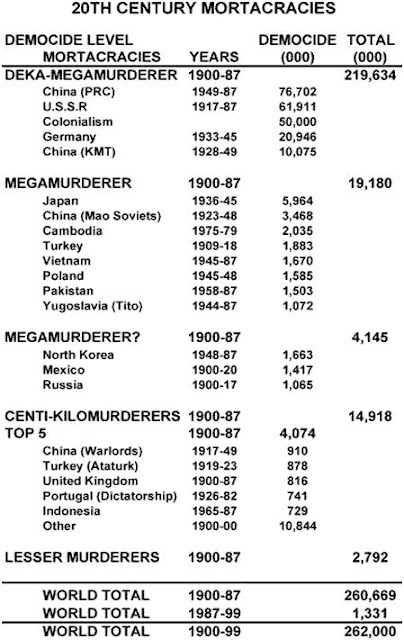
This total contrasts with the total Democide (Murder by Government) of 1,670,000. Nearly twice as many people were murdered by the Communist Vietnam government as died on both sides of the entire war. http://en.wikipedia.org/wiki/Rudolph_Rummel
Sadly, the Americans were also guilty of Democide. Professor Rummel calculates that approximately 6,000 Vietnamese were murdered by American servicemen. I am ashamed and sorry for this but it is a tiny fraction of the murder committed by the Vietnamese Communists. And certainly nothing like the lies and propoganda generated by our anti war protesters. https://www.hawaii.edu/powerkills/MURDER.HTM
The End of the Vietnam War
Historians have directly attributed the fall of Saigon in 1975 to the cessation of American aid. Without the necessary funds, South Vietnam found it logistically and financially impossible to defeat the North Vietnamese army. Moreover, the withdrawal of aid encouraged North Vietnam to begin an effective military offensive against South Vietnam.
Given the monetary and military investment in Vietnam, former Assistant Secretary of State Richard Armitage compared the American withdrawal to “a pregnant lady, abandoned by her lover to face her fate." (2) Historian Lewis Fanning went so far as to say that “it was not the Hanoi communists who won the war, but rather the American Congress that lost it." (3)
In January of 1973, President Richard Nixon approved the Paris Peace Accords negotiated by Henry Kissinger, which implemented an immediate cease-fire in Vietnam and called for the complete withdrawal of American troops within sixty days. Two months later, Nixon met with South Vietnamese President Thieu and secretly promised him a “severe retaliation” against North Vietnam should they break the cease-fire. Around the same time, Congress began to express outrage at the secret illegal bombings of Cambodia carried out at Nixon’s behest. Accordingly, on June 19, 1973 Congress passed the Case-Church Amendment, which called for a halt to all military activities in Southeast Asia by August 15, thereby ending twelve years of direct U.S. military involvement in the region.
In the fall of 1974, Nixon resigned under the pressure of the Watergate scandal and was succeeded by Gerald Ford. Congress cut funding to South Vietnam for the upcoming fiscal year from a proposed 1.26 billion to 700 million dollars. These two events prompted Hanoi to make an all-out effort to conquer the South. As the North Vietnamese Communist Party Secretary Le Duan observed in December 1974: “The Americans have withdrawn…this is what marks the opportune moment." (4)
The NVA drew up a two-year plan for the “liberation” of South Vietnam. Owing to South Vietnam’s weakened state, this would only take fifty-five days. The drastic reduction of American aid to South Vietnam caused a sharp decline in morale, as well as an increase in governmental corruption and a crackdown on domestic political dissent. The South Vietnamese army was severely under-funded, greatly outnumbered, and lacked the support of the American allies with whom they were accustomed to fighting.
The NVA began its final assault in March of 1975 in the Central Highlands. Ban Me Thout, a strategically important hamlet, quickly fell to North Vietnam. On March 13, a panicked Thieu called for the retreat of his troops, surrendering Pleiku and Kontum to the NVA. Thieu angrily blamed the US for his decision, saying, “If [the U.S.] grant full aid we will hold the whole country, but if they only give half of it, we will only hold half of the country.”5 His decision to retreat increased internal opposition toward him and spurred a chaotic mass exodus of civilians and soldiers that clogged the dilapidated roads to the coast. So many refugees died along the way that the migration along Highway 7B was alternatively described by journalists as the “convoy of tears” and the “convoy of death.” 6
On April 21, President Thieu resigned in a bitter televised speech in which he strongly denounced the United States. Sensing that South Vietnam was on the verge of collapse, the NVA accelerated its attack and reached Saigon on April 23. On the same day, President Ford announced to cheerful students at Tulane University that as far as America was concerned, “the war was over.” The war officially concluded on April 30, as Saigon fell to North Vietnam and the last American personnel were evacuated.
- See more at: http://hnn.us/article/31400#sthash.5G5fI2Ac.dpuf
Given the monetary and military investment in Vietnam, former Assistant Secretary of State Richard Armitage compared the American withdrawal to “a pregnant lady, abandoned by her lover to face her fate." (2) Historian Lewis Fanning went so far as to say that “it was not the Hanoi communists who won the war, but rather the American Congress that lost it." (3)
In January of 1973, President Richard Nixon approved the Paris Peace Accords negotiated by Henry Kissinger, which implemented an immediate cease-fire in Vietnam and called for the complete withdrawal of American troops within sixty days. Two months later, Nixon met with South Vietnamese President Thieu and secretly promised him a “severe retaliation” against North Vietnam should they break the cease-fire. Around the same time, Congress began to express outrage at the secret illegal bombings of Cambodia carried out at Nixon’s behest. Accordingly, on June 19, 1973 Congress passed the Case-Church Amendment, which called for a halt to all military activities in Southeast Asia by August 15, thereby ending twelve years of direct U.S. military involvement in the region.
In the fall of 1974, Nixon resigned under the pressure of the Watergate scandal and was succeeded by Gerald Ford. Congress cut funding to South Vietnam for the upcoming fiscal year from a proposed 1.26 billion to 700 million dollars. These two events prompted Hanoi to make an all-out effort to conquer the South. As the North Vietnamese Communist Party Secretary Le Duan observed in December 1974: “The Americans have withdrawn…this is what marks the opportune moment." (4)
The NVA drew up a two-year plan for the “liberation” of South Vietnam. Owing to South Vietnam’s weakened state, this would only take fifty-five days. The drastic reduction of American aid to South Vietnam caused a sharp decline in morale, as well as an increase in governmental corruption and a crackdown on domestic political dissent. The South Vietnamese army was severely under-funded, greatly outnumbered, and lacked the support of the American allies with whom they were accustomed to fighting.
The NVA began its final assault in March of 1975 in the Central Highlands. Ban Me Thout, a strategically important hamlet, quickly fell to North Vietnam. On March 13, a panicked Thieu called for the retreat of his troops, surrendering Pleiku and Kontum to the NVA. Thieu angrily blamed the US for his decision, saying, “If [the U.S.] grant full aid we will hold the whole country, but if they only give half of it, we will only hold half of the country.”5 His decision to retreat increased internal opposition toward him and spurred a chaotic mass exodus of civilians and soldiers that clogged the dilapidated roads to the coast. So many refugees died along the way that the migration along Highway 7B was alternatively described by journalists as the “convoy of tears” and the “convoy of death.” 6
On April 21, President Thieu resigned in a bitter televised speech in which he strongly denounced the United States. Sensing that South Vietnam was on the verge of collapse, the NVA accelerated its attack and reached Saigon on April 23. On the same day, President Ford announced to cheerful students at Tulane University that as far as America was concerned, “the war was over.” The war officially concluded on April 30, as Saigon fell to North Vietnam and the last American personnel were evacuated.
- See more at: http://hnn.us/article/31400#sthash.5G5fI2Ac.dpuf
Sources / References
There is a great deal of misinformation about the Vietnam war and its aftermath. Many anti war people simply made up stories that became oft quoted and then became facts and remain believed today. Example - it was widely claimed that African Americans died in much higher numbers than whites in Vietnam. In reality blacks suffered 12.5% of the deaths in Vietnam at a time when the percentage of blacks of military age was 13.5% of the total population.
I rely heavily on the work of Professor Rummel (Oct 21, 1932 – Mar 2, 2014) of the University of Hawaii who has published extensively on genocide. He uses the term democide which he defines as "the murder of any person or people by their government, including genocide, politicide and mass murder."
Other books include:
Applebaum, Anne. Gulag : A History. Doubleday, 2003.
I rely heavily on the work of Professor Rummel (Oct 21, 1932 – Mar 2, 2014) of the University of Hawaii who has published extensively on genocide. He uses the term democide which he defines as "the murder of any person or people by their government, including genocide, politicide and mass murder."
Death by Government by Professor R. J. Rummel of the University of Hawaii. https://www.hawaii.edu/powerkills/
Other books include:
Applebaum, Anne. Gulag : A History. Doubleday, 2003.
Conquest, Robert. The Harvest of Sorrow: Soviet Collectivization and the Terror-Famine. University of Alberta Press, 1986.
Conquest, Robert. Kolyma: The Arctic Death Camps. Viking Press, 1978.
Conquest, Robert. The Nation Killers: The Soviet Deportation of Nationalities. Macmillan, 1970.
Heller, Mikhail and Nekrich, Aleksandr. Utopia in Power.
History of the Soviet Union from 1917 to the Present. Summit Books, 1986.
Werth, Nicolas; Panne, Jean-Louis; Paczkowski, Andrzej; Bartosek, Karel; Margolin, Jean-Louis; Courtois, Stephane. The Black Book of Communism: Crimes, Terror, Repression. Harvard University Press, 1999.
The Harvest of Sorrow: Soviet Collectivization and the Terror-Famine by Robert Conquest’s
References on Murder
Professor Rudy Rummel of the University of Hawaii has published extensive referenced and documented estimates on murder by government, which he terms democide. The tables below summarizes some of his work. It should be noted that various scholars have different opinions about deaths, especially in those totalitarian Communist Countries where little information is made available. We know the most about Democide committed by the Nazi's and Japanese after we conquered them in World War II. We also have more information about Cambodia, who exposed the horrific murders committed by the Communist Khmer Rouge after they were deposed. The USSR also made some information available when they exposed the murders committed by Stalin. We know less about the democide committed by Vietnam, Laos, and China, since the same evil communist government is in place.


Murder Estimates
Numerous studies and estimates have been made on the genocide committed in Vietnam, Laos, and Cambodia. It is difficult to determine the actual number of people murdered. Estimates vary widely.
Some of the estimates are listed below.
Some of the estimates are listed below.
| Second Indochina War (1960-75): 4 200,000 [make link] |
| Vietnam War (1965-73): 1 700,000 |
|
| Sub-Wars |
|
| Atrocities: |
|
| Vietnam War Sources: |
|
| Cambodia, Khmer Rouge (1975-1978): 1,650,000 [make link] |
|
Subscribe to:
Posts (Atom)